
A model-specific maintenance plan for dryers, refrigerators, washers, dishwashers, and cooking appliances—plus popular habits that do not prevent failures.
Looking for verified appliance-repair specialists? Check availability in seconds.
Check ZIP code availabilityMaintenance protects conditions—it does not promise a lifespan
No maintenance routine can guarantee that a refrigerator compressor, washer bearing, dishwasher control, or oven element will last a specified number of years. What good maintenance can do is preserve required airflow, drainage, sealing, and safe electrical or gas conditions. It can also expose a small leak, damaged cord, slow vent, or loose part before the secondary damage becomes larger.
The best schedule begins with the exact model's use-and-care manual. Appliances that look alike may use different condenser layouts, self-cleaning or manual dishwasher filters, pump access, detergents, cleaning chemicals, and disassembly limits. A universal online calendar can tell an owner to open something the manufacturer calls service-only—or ignore a task the model actually requires.
Treat maintenance as risk reduction and early detection, not a way to reset the appliance's age. Manufacturing variation, installation, household load, water chemistry, room temperature, voltage, part support, and plain chance still affect useful life.
Build one model-specific appliance record
Photograph each model and serial plate, the purchase receipt, installation invoice, written warranty, and any service-contract terms. Download the current owner manual and parts diagram while the model is easy to find. Record the installation date, repairs, error codes, leaks, and maintenance performed. This small file improves warranty claims and prevents the wrong filter, hose, gasket, or cleaning method from being used.
Check the CPSC recall database by model and serial number at purchase, after a move, and whenever unusual heat, smoke, electrical behavior, fire, or a manufacturer alert appears. A recall remedy may require owners to stop use and obtain a defined repair, replacement, or refund. Routine cleaning is not a substitute for a safety remedy.
Create intervals from the manual, then adjust using visible condition and operating symptoms. Pets, frequent loads, long dryer ducts, greasy cooking, hard water, and a dusty room may justify more frequent checks. Maintenance that suddenly becomes necessary much more often can be evidence of an installation or component problem—not proof that the schedule should simply get shorter.
Dryer maintenance has the clearest safety payoff
Clean the lint screen before or after every load and inspect it for tears, warping, or residue that blocks the mesh. Longer drying time, unusually hot clothes or laundry room, a burning smell, shutdown before clothes are dry, or weak flow at the exterior termination are warning signs. Stop using the dryer for smoke, scorching, fire, or a gas odor and use the appropriate emergency response.
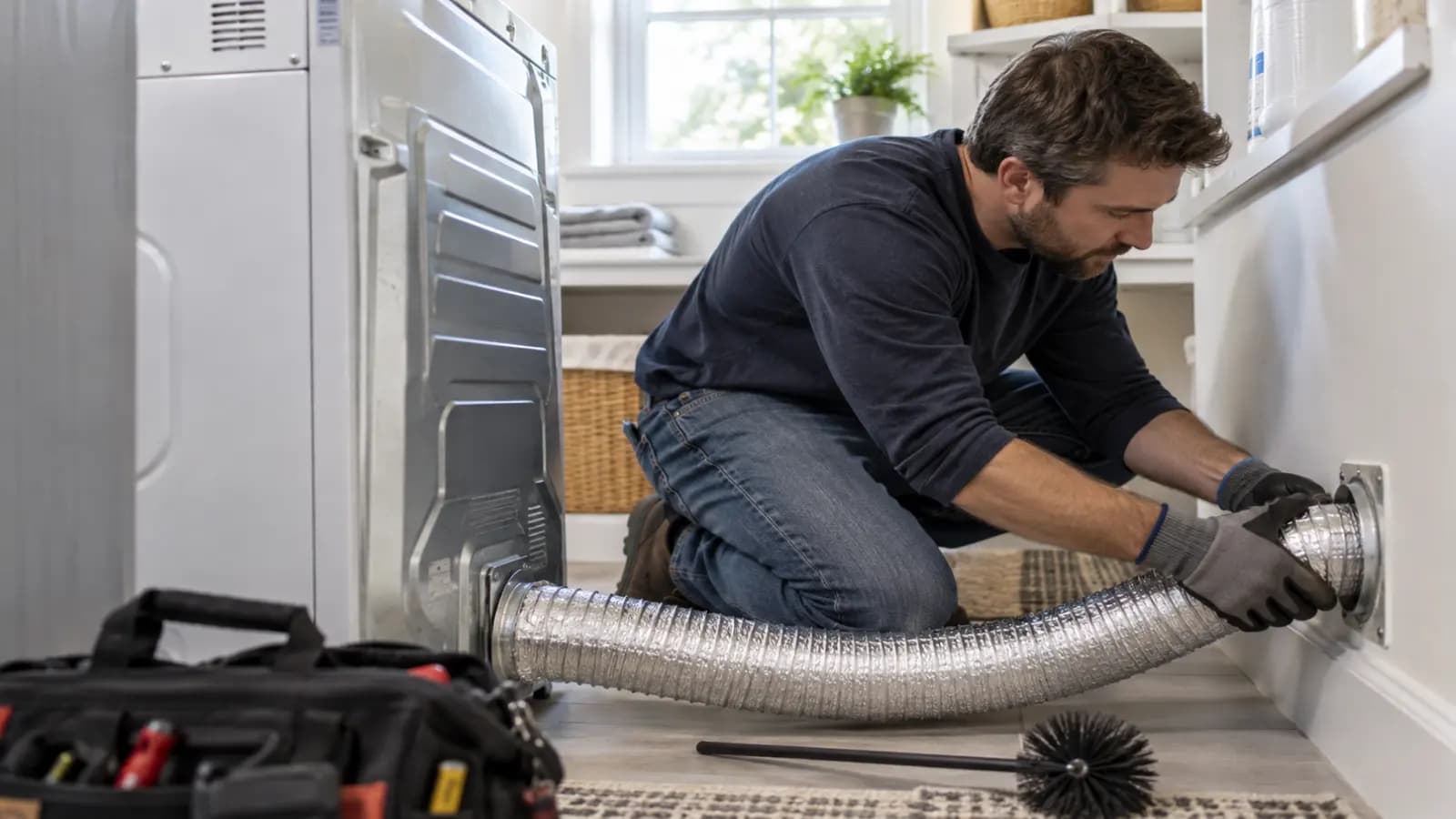
CPSC advises periodic cleaning of the dryer vent and exhaust duct, checking that exhaust escapes outdoors, cleaning behind the dryer, and replacing plastic or foil accordion-style duct with the rigid or corrugated semi-rigid metal duct specified by most manufacturers. The U.S. Fire Administration advises cleaning dryer vent ductwork yearly. The actual job can need earlier attention when loads dry slowly or the duct is long, bent, crushed, shared, inaccessible, or serving a high-use household.
Do not run the dryer disconnected into the room, use screws that project into the airflow unless the manufacturer permits them, or push the machine back far enough to crush the transition duct. Interior cabinet cleaning, gas connections, concealed ducts, roof terminations, and ducts that cannot be fully inspected may warrant a qualified appliance or vent professional. Verify reconnection and exterior airflow before normal use.
Refrigerators need airflow, sealing, and the correct environment
Keep the door gasket and mating surface clean, remove packages that prevent closure, and check for tears, folds, condensation, or localized frost. Confirm the unit is stable and the doors align according to the manual. Minimize unnecessary door-open time and keep interior supply and return vents clear without packing food against them.
Maintain the installation clearances and ambient-temperature range listed for the model. ENERGY STAR recommends allowing air circulation and keeping condenser coils clean on applicable older models, while telling owners to consult the manual for safe cleaning. Some refrigerators have owner-accessible coils; others enclose them. Do not remove a service panel or move a large connected refrigerator alone because a generic checklist says to vacuum twice a year.
Use an appliance thermometer to verify 40°F or below in the refrigerator and 0°F or below in the freezer. Track a rising temperature, persistent frost, water, unusual cycling, repeated error, or doors that no longer seal. Cleaning may restore compromised airflow; it cannot repair a refrigerant leak, compressor, fan, sensor, control, or defrost failure.
Washers benefit from correct loads, detergent, and moisture control
Use the detergent type and amount specified for the machine, load, soil, and water conditions. More detergent is not more cleaning: excess suds and residue can interfere with rinsing, collect in dispensers and seals, and contribute to odor or leaking. Do not exceed the model's load guidance, force one bulky item into a machine not rated for it, or wash materials the manual excludes.
After the final load, remove laundry promptly, clear hair or debris from the door glass and gasket, wipe retained water where the manual directs, and allow the tub and dispenser to dry in the manufacturer-approved position. Keep children and pets away from an open washer. Clean the dispenser, tub, gasket, inlet screens, or pump filter only at the model's stated interval and method; residual water can be hot, and a poorly reseated filter cap can create a leak.
Inspect accessible supply hoses, connections, shutoffs, drain hose, and floor for moisture, corrosion, bulges, abrasion, or movement. Follow the appliance and hose manufacturer's replacement requirements rather than assuming every hose has one universal service life. Stop for an active leak, burning smell, shock, repeated breaker trip, severe vibration, or a machine that moves despite correct loading and leveling.
Dishwasher filter care depends on the filter design
Some dishwashers have a removable manual-clean filter; others use a self-cleaning or maintenance-free arrangement. Find the filter type in the exact manual before twisting anything in the sump. Whirlpool's own guidance describes both types, which is why “clean every dishwasher filter monthly” is not a safe universal instruction.
For a removable filter, follow the specified removal direction, rinse or softly brush it, inspect for damage, and lock it fully into place. Never operate the dishwasher with a required filter missing or loose. Inspect spray arms and clear only as the manual allows. Scrape the food soils the manufacturer says to remove, load dishes so they do not block spray or the detergent door, and use detergent and rinse aid appropriate to the model and local water.
A cleaner or descaler can address certain grease, odor, or mineral deposits when the manufacturer recommends it, but it does not replace physical filter care or correct a drain, heater, pump, valve, or water-quality problem. Never mix cleaning chemicals. Stop for smoke, burning odor, active leakage, standing water near electrical equipment, broken glass in an inaccessible area, or an error that the manual sends to service.
Cooking appliances need cleanliness without defeated safeguards
Keep range and cooktop burners, caps, igniters, ports, drip areas, and ventilation surfaces clean using only the model-approved method. Reassemble removable burner parts exactly as shown and verify normal ignition before cooking. Clean spills after the surface is cool; accumulated grease is a fire risk, while harsh abrasives and flooded controls can damage finishes or electrical components.
Use an oven's self-clean feature only if and how the manufacturer directs, remove the listed racks and accessories, ventilate the room, and never leave a hazardous condition unattended. Self-clean is a high-temperature cycle, not preventive repair. Stop for persistent gas odor, delayed or abnormal ignition, sparking outside an igniter, smoke unrelated to food residue, a door that will not lock or unlock correctly, or repeated electrical trips.
For a microwave, keep the cavity, door, latch area, and waveguide cover clean without damaging the cover or seal. Never operate it empty or with a damaged door, hinge, latch, seal, cord, or signs of arcing. The high-voltage capacitor can retain dangerous energy after unplugging, so the cabinet stays closed for homeowner care. Disposal maintenance likewise means correct use and clearing only by the manufacturer method—not putting hard or starchy waste through it as a supposed sharpening treatment.
Protect the installation around the appliance
Many failures blamed on an appliance start outside it: a crushed dryer duct, inadequate receptacle, unstable floor, clogged air gap, closed water valve, leaking shutoff, poor drain arrangement, excessive water pressure, blocked ventilation, extreme garage temperature, or cabinet opening that traps heat. Compare the installation with the current manual after a remodel, move, floor replacement, or new countertop.
Plug major appliances directly into suitable wall outlets as instructed. The U.S. Fire Administration warns against extension cords for refrigerators, washers, dryers, and other major appliances because the cord can overheat. Do not remove grounding pins, use improvised adapters, or keep resetting protection that trips. Have damaged cords, loose outlets, hot plugs, arcing, or recurring trips evaluated by an appropriately qualified professional.
Water alarms and correctly selected pans can limit discovery time or property damage in some locations, but they do not make a leaking connection acceptable and must not obstruct ventilation, leveling, drain access, or manufacturer clearances. A pan without a safe drainage or alarm plan can simply hide a slow leak until it overflows.
Common appliance-maintenance myths
A useful maintenance plan avoids rituals that add cost, damage components, or conceal the real problem.
Know the boundary between cleaning and repair
Disconnect power and shut off water or gas only where the manual instructs and the control is safely accessible. Do not work around standing water, energized components, hot surfaces, moving parts, sharp cabinet edges, gas fittings, sealed refrigeration circuits, microwave high-voltage parts, or a heavy appliance that can tip or crush. Manufacturer instructions and local trade rules determine when a qualified servicer, electrician, plumber, gas fitter, or vent specialist is appropriate.
Preserve error codes and photograph the condition before resetting or cleaning. Stop when maintenance reveals melted insulation, scorch marks, oily refrigerant residue, structural corrosion, a torn belt or seal beyond owner access, recurring water, excessive play or grinding, unsafe ignition, or a recall. Repeatedly cleaning around a developing failure can erase evidence while damage continues.
For service, provide the model, serial, age, installation, symptoms, error history, photos, maintenance performed, and warranty information. Ask for a written diagnosis, complete price, part source, return-visit terms, and parts and labor warranties rather than approving a component from a symptom-only guess.
A practical maintenance rhythm
After each use or load, do the fast tasks the manual requires: dryer lint screen, spill cleanup, correct loading, door closure, and removal of washer moisture or dishwasher debris when visible. Monthly, inspect cords and plugs without disturbing them, look under and around water-connected appliances, review gaskets and vents, and perform only the model-listed filter or cleaning cycle due at that interval.
Seasonally or at the manual's interval, inspect dryer airflow and duct condition, appliance clearances, accessible hoses and connections, refrigerator temperatures, and filters or coils designed for owner service. Annually, review the complete dryer exhaust path, recall status, service history, and whether worsening time, heat, noise, vibration, leakage, or energy use calls for diagnosis rather than more cleaning.
Log the date, observation, and action in one note. The trend is valuable: a filter clogging twice as fast, dryer time slowly increasing, gasket repeatedly collecting water, or a refrigerator running longer can point to an operating, installation, or component change before outright failure.
The bottom line
Appliance maintenance works best when it preserves airflow, drainage, sealing, cleanliness, correct loading, and a safe installation according to the exact model. Dryer lint and exhaust care carries a clear fire-safety benefit; refrigerator, washer, and dishwasher tasks depend heavily on design. Skip universal schedules, miracle cleaners, extra detergent, and any procedure that crosses into disassembly or safety-system bypass.
If maintenance reveals abnormal heat, electrical trouble, a recurring leak, poor cooling, failed drainage, unusual noise, or a persistent error, submit your ZIP code, appliance model, age, and symptoms to request a free match with independent local appliance-repair technicians. Check recall and warranty status and obtain a written diagnosis and price before authorizing work; there is no obligation to hire a matched provider.
Frequently asked questions
What appliance maintenance is most important?
Dryer lint-screen and exhaust-path care has a direct fire-safety benefit. Beyond that, follow each model's manual for door seals, airflow clearances, filters, moisture removal, cleaning cycles, hoses, and permitted coil care. Correct installation and early attention to leaks, heat, error codes, and abnormal operation matter as much as cleaning.
How often should refrigerator coils be cleaned?
There is no safe universal interval for every refrigerator. Some models have owner-accessible coils that require periodic cleaning; others use enclosed condensers. Follow the exact manual and inspect permitted areas more often in dusty or pet-heavy conditions. Do not remove a service panel or move a connected refrigerator alone.
Does a dishwasher filter need cleaning every month?
Not necessarily. Some dishwashers use removable manual-clean filters, while others have self-cleaning or maintenance-free designs. Identify the system in the owner manual and use its interval. A removable filter must be reinstalled and locked correctly before operation.
Does leaving a washer door open prevent mold?
Allowing the tub and dispenser to dry can reduce retained moisture and odor when the manufacturer recommends it. Also remove laundry promptly, wipe the gasket as directed, use the correct detergent amount, and run the specified cleaning cycle. Keep children and pets away from an open machine.
Can regular maintenance prevent appliance repairs?
It can prevent or reduce some problems related to restricted airflow, debris, residue, poor sealing, incorrect loading, and unnoticed leaks. It cannot prevent every electronic, motor, bearing, compressor, heater, or manufacturing failure. Maintenance should reveal worsening symptoms early, not guarantee a repair-free lifespan.
Cost ranges here are general research estimates compiled from national and regional data. They are not quotes, offers or price guarantees — only a licensed provider who has seen the job can price it. GetLocalExperts is a free matching service and does not perform home services.
Sources and further reading
- Appliance and Electrical Fire Safety — U.S. Fire Administration
- Basement and Garage Fire Safety — U.S. Fire Administration
- Overheated Clothes Dryers Can Cause Fires — U.S. Consumer Product Safety Commission
- Refrigerators — ENERGY STAR
- How to Clean the Dishwasher Filters — Whirlpool Product Help
- Front Load Washer Maintenance — LG USA Support
- Recalls and Product Safety Warnings — U.S. Consumer Product Safety Commission
This guide was researched and reviewed by the GetLocalExperts Editorial Team against primary regulatory benchmarks, state contractor licensing board standards, and FTC consumer protection guidelines.