Secure broken glazing safely, locate where condensation occurs, identify the replaceable component, and compare glass, sash, and full-window scopes before ordering.
Looking for verified window-installation specialists? Check availability in seconds.
Check ZIP code availabilityTreat broken glass as an opening hazard first
Keep children, pets, and unprotected occupants away from the interior and exterior fall zone. Do not touch a pane that is bowed, loose, overhead, high above grade, part of a door, or likely to release unexpectedly. Call emergency services when people are threatened, and use a qualified glazier or board-up service for unstable, large, laminated, tempered, insulated, elevated, or storefront-style glazing.
Do not press tape onto glass that may collapse, pull shards from the frame, lean a ladder against the opening, or improvise a board that loads damaged glass. A professional temporary closure should resist weather and unauthorized entry without fastening into concealed wiring, plumbing, structural members, or a drainage path. Do not block an occupied room's required emergency escape without arranging a safe alternative approved where necessary.
If cleanup can be performed without approaching unstable glass, wear sturdy footwear, eye protection, and cut-resistant gloves appropriate to the task. Use a rigid, puncture-resistant container and follow local disposal rules. Tiny transparent fragments travel beyond the visible break; isolate the area until it has been inspected and cleaned. Never reach into a disposal bag or compact glass by hand.
Document the break before temporary work changes the evidence
Photograph the full window from inside and outside, the break pattern without approaching it, impact point if visible, surrounding frame and wall, water entry, damaged contents, and any storm debris or suspected object. Record discovery time, weather, security issue, and what was done to protect the opening. Notify the insurer, landlord, property manager, association, police, or responsible party as circumstances require.
Preserve labels, etched markings, invoices, warranty papers, installation records, and any failed hardware or retained sample when safe. Do not state a cause as fact until evaluated; thermal stress, edge damage, impact, building movement, installation stress, inclusions, hardware contact, and other conditions can produce different failures. A repair invoice should distinguish observed condition from suspected cause.
Emergency board-up and permanent glazing are different scopes. Confirm who measures, orders, secures, removes temporary materials, repairs finishes, disposes of glass, and returns after the custom unit arrives. Document whether the room remains weather-tight, secure, and usable during the lead time.
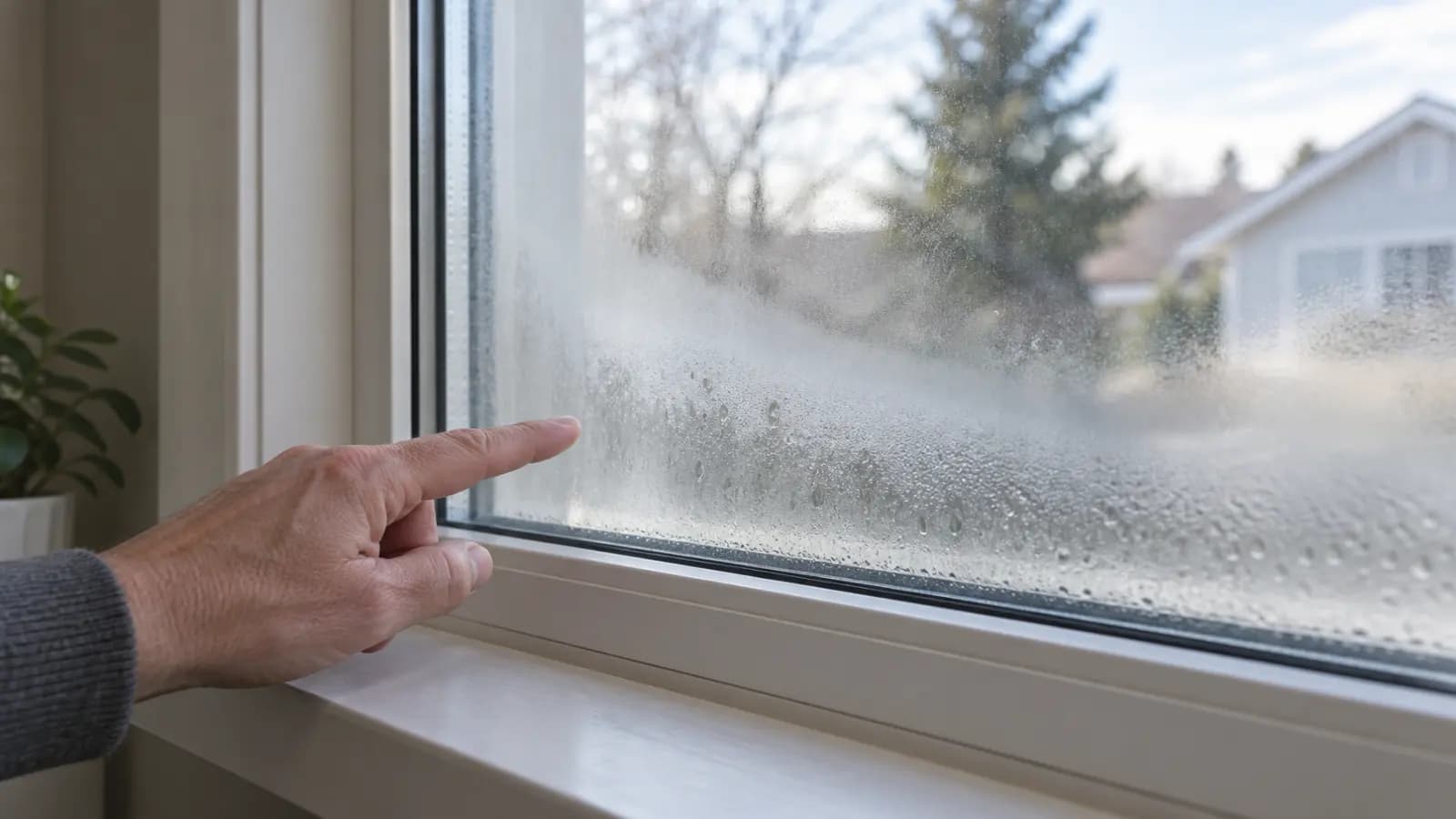
First locate the fog or moisture
Wipe the room-side surface and, from a safe accessible location, the exterior surface. Moisture that wipes from the room side is interior-surface condensation; moisture that wipes from outside is exterior-surface condensation. Haze, droplets, mineral tracks, or deposits that cannot be reached because they sit between panes indicate an insulated-glass-unit condition. Dirt trapped behind a removable storm or between separate sash and storm layers is another case.
Interior condensation occurs when a glass or frame surface is below the indoor air's dew point. Indoor humidity, outdoor temperature, glass and frame performance, air movement, shades, curtains, deep sills, and localized air leakage all affect it. Persistent water can damage finishes and support mold on nearby materials, so document location and conditions rather than blaming the seal automatically.
Exterior condensation can occur when an efficient exterior pane becomes colder than outdoor dew-point conditions, often overnight. It may be temporary and does not by itself prove failure. Moisture between sealed panes is different: it indicates the insulated glass no longer maintains its intended sealed space, although a glazier or manufacturer should confirm the component and remedy.
Diagnose the cause before choosing a replacement boundary
Inspect glass, glazing beads or stops, gaskets, sealants, sash joints, drainage openings, weeps, hardware, frame corners, sill, exterior trim, flashing interfaces, wall staining, and operation. Water on the sill can result from condensation, wind-driven rain through the unit, blocked drainage, failed perimeter sealant, wall leakage above, or interior humidity. The visible location is not necessarily the entry point.
Test operation without forcing damaged glazing. Record binding, failed balances, hinges, locks, compression seals, loose sash, corrosion, rot, distortion, and drainage obstruction. Measure moisture and probe suspect wood when appropriate, but recognize that one meter reading does not map a concealed wall or identify the source.
Escalate recurring leakage, multiple unexplained glass breaks, displaced frames, masonry cracks, wall softness, structural movement, or widespread moisture to the qualified trade or building-envelope/structural professional needed locally. Replacing glass cannot repair a moving opening, failed wall flashing, or active leak.
Know the four practical repair levels
Single-pane reglazing replaces an individual lite and the compatible glazing materials or stops that retain and weather-seal it. An insulated glass unit, or IGU, is a factory-sealed assembly of two or more panes, spacer, and seals; replacing it retains a serviceable sash and frame. A sash replacement changes the operable or fixed glazed panel while retaining the main frame. Full-window replacement changes the complete unit by an insert or full-frame method.
Choose the smallest boundary that corrects the documented failure and remains supported by available parts, safety requirements, product instructions, appearance, and warranty. Glass-only work can be sensible when the sash and frame are suitable and reglazing is an approved, durable procedure. Sash replacement may preserve factory glazing and be simpler when an exact part is available.
Full replacement becomes a candidate when the frame or retained installation is deteriorated or incompatible, operation and hardware problems are extensive, the opening or performance must change, required parts are unavailable, multiple component repairs approach the complete scope, or water-management access is needed. It is not automatically required merely because several IGUs of the same age have fogged.
Match the replacement glass to safety and performance requirements
Do not order from visible dimensions alone. A glazier needs the daylight opening and the actual glazing pocket or removable-unit dimensions, thickness, pane construction, spacer, coatings and coated surfaces, tint, pattern, grids, shape, edge details, safety glazing, laminated or impact requirements, and compatibility with the sash, setting blocks, gaskets, sealants, and weeps.
Safety glazing requirements depend on the opening's location, size, walking surface, doors, tubs and showers, stairs, guards, adopted code, and local amendments. Tempered, laminated, and other compliant materials behave differently. Preserve permanent safety markings and require the proposal to state the glazing type and applicable certification; do not infer compliance from a broken pattern or one faint mark.
Replacing one pane or IGU may change color, reflectance, low-E appearance, grid alignment, edge spacer, visible distortion, and performance relative to adjacent units. Ask for a sample or written matching limitation. In historic assemblies, consult preservation requirements before discarding original sash or glass.
A drilled or vented fog treatment is not the same as restoring an IGU
Some services drill small holes, clean or vent the cavity, or apply a treatment intended to improve appearance. Ask exactly what is removed, what remains, whether the original sealed insulating space and gas fill are restored, how openings are closed, what performance is claimed, and which warranty covers haze, spots, water entry, and thermal performance.
Clearing visible moisture does not automatically recreate the factory IGU or its certified whole-product rating. NFRC ratings apply to certified product configurations, not an assumption about field-modified glass. If energy performance, condensation resistance, warranty, or resale documentation matters, compare the treatment with a factory-made replacement IGU or sash using written evidence.
Do not accept claims that a cosmetic treatment permanently repairs every seal failure or restores a specific percentage of efficiency without substantiation. Compare complete price, expected appearance, access, warranty, service life uncertainty, and whether the underlying edge, sash, drainage, or frame problem remains.
Manage room-side condensation as a house-and-window condition
Start by measuring indoor temperature and relative humidity near the affected room and noting outdoor conditions, cooking, bathing, drying laundry, humidifier use, closed shades, furniture blocking airflow, and ventilation operation. Use source control and effective outdoor-vented exhaust where appropriate. Do not prescribe one indoor humidity percentage for every outdoor temperature, house, occupant, and window.
Check whether condensation occurs on the glass center, edge, frame, one room, one orientation, or every window. Edge-of-glass and frame temperatures differ from center glass. Air leakage can chill surfaces, while tight coverings can reduce warm-room airflow. NFRC condensation ratings can help compare products, but they do not guarantee that condensation will never occur in a specific home.
Address water promptly: protect finishes, clean visible microbial growth safely, and investigate wet cavities or damaged trim. Do not seal drainage paths, paint over decay, or replace an IGU solely to cure indoor moisture. Persistent condensation may warrant HVAC, ventilation, insulation, air-leakage, or building-envelope evaluation.
Check the warranty before authorizing destructive work
Identify the manufacturer and product from frame labels, sash labels, spacer markings, etched codes, invoices, permits, prior-owner records, or installer documentation. Photograph everything before removing glazing beads or labels. Record installation date, original purchaser, property address, glass code, affected quantity, symptoms, and proof of purchase if available.
There is no universal 10- or 20-year glass warranty. Coverage can differ for IGU seal failure, spontaneous glass breakage, stress cracks, tempered breakage, screens, hardware, finish, labor, shipping, diagnosis, removal, access, and consequential damage. Transferability, registration, prorating, exclusions, coastal exposure, installation method, and claim procedure vary.
Obtain written claim authorization and understand who pays labor and finishing before ordering. Unauthorized glass removal or field modification may affect evidence or coverage. Keep the final glass code, invoice, photographs, warranty, installer contact, and care instructions for the next claim.
Pre-1978 glazing work may disturb lead-painted components
Replacing glass or a sash is not always treated as complete window replacement under EPA's RRP framework, but it can still disturb painted glazing compound, stops, sash, hinges, or fasteners. Coverage depends on the work and the rule's minor-repair definition and other provisions. Complete window replacement has specific treatment under the rule.
For paid work affecting paint in pre-1978 housing, ask the contractor how federal or authorized-state lead requirements apply, what surfaces are disturbed, who is certified, and how containment, cleaning, verification, waste, and records will be handled. EPA recommends lead-safe practices for homeowners undertaking their own covered-age renovation work.
Also flag suspected asbestos-containing glazing compounds, sealants, or adjacent siding, especially before sanding, grinding, cutting, or demolition. Applicable state and local requirements may exceed federal rules. Emergency stabilization should be limited to what is needed for safety and followed by compliant permanent work.
Compare repair quotes component by component
Give each bidder the same opening ID, photographs, observed symptom, product information, access condition, and desired outcome. Require the diagnostic assumption and alternate price if the frame, sash, or wall proves unsuitable. A low “glass price” may exclude measurement, temporary board-up, custom freight, upper-story access, stops, finish, safety glazing, disposal, or a return visit.
Emergency protection, site security, weather protection, glass cleanup, temporary-closure removal, access equipment, and occupied-area protection
Opening ID; single pane, IGU, sash, insert, or full-frame boundary; retained-component condition; cause assumptions; and concealed-damage procedure
Glass dimensions and makeup, thickness, coatings, tint, grids, spacer, safety or impact construction, markings, matching limitations, and certified ratings where applicable
Glazing beads, stops, setting blocks, gaskets, sealants, weeps, sash repair, hardware, drainage, perimeter work, trim, paint, wall repair, and water testing if specified
Lead-safe and other hazardous-material assumptions, permits or code review, disposal, schedule, deposit, change orders, insurance coordination, and responsibility for broken items or water entry
Manufacturer claim, glass warranty, seal-failure coverage, labor and service warranty, exclusions, punch list, operation test, labels, photos, invoice, and maintenance instructions
The bottom line
Broken glazing needs a safe perimeter and weather/security response before a sales decision. Fog requires one more basic step: locate it. Room-side, exterior-side, storm-panel, and between-pane moisture have different causes. After diagnosis, select among pane, IGU, sash, or complete-window work based on the failed component, retained condition, drainage, operation, safety requirements, available parts, appearance, warranty, and total installed scope.
If you need a window assessment or repair quote, submit your ZIP code, room and story, break or fog location, window operation and frame material, approximate age, labels or etched codes, leak or operation history, home age, access limits, and insurer or warranty status to request a free match with independent local window professionals. Keep away from unstable glass and use emergency help when needed. Verify qualifications, insurance, lead-safe certification when applicable, written glazing specification, and warranties before hiring; there is no obligation to choose a matched provider.
Frequently asked questions
Can a foggy double-pane window be repaired without replacing the whole window?
Often the failed insulated glass unit or exact sash can be replaced while a suitable frame remains. Confirm that fog is between sealed panes and inspect sash, frame, drainage, operation, parts availability, appearance, and warranty. Drilled or vented treatments are not automatically equivalent to a factory-sealed replacement IGU.
Does condensation between window panes mean the seal failed?
Persistent moisture, haze, or deposits truly inside a sealed IGU indicate that its sealed space is no longer performing as intended. First verify the moisture cannot be wiped from the room or exterior surfaces and is not between a separate storm and sash. A glazier or manufacturer can confirm the component and remedy.
Should I replace the glass, sash, or entire window?
Replace the smallest supported component that corrects the documented failure. Glass or IGU work suits a serviceable sash and frame; an exact sash can solve glazing plus sash problems; full replacement becomes a candidate for frame deterioration, failed wall integration, extensive operation problems, changed performance, unavailable parts, or uneconomic combined repairs.
Is condensation on the inside of a window a failed seal?
Usually it is moisture from indoor air condensing on a cold room-side surface, not moisture between panes. Measure indoor conditions and examine ventilation, moisture sources, shades, airflow, air leakage, and window performance. Persistent water still deserves attention because it can damage adjacent materials.
Does broken replacement glass need to be tempered?
Safety-glazing requirements depend on the opening's location, size, proximity to doors, tubs, showers, stairs, guards and walking surfaces, plus adopted code and local amendments. The replacement should preserve or satisfy the required compliant glazing and permanent markings. Have the glazier and local authority confirm rather than ordering from appearance alone.
General planning information, not emergency, glazing, structural, building-envelope, lead, or code advice. Broken glass, unstable openings, elevated work, and damaged walls can be dangerous. Keep people away and use emergency services or appropriately qualified local professionals as conditions require.
Sources and further reading
- National Fenestration Rating Council Ratings and Window Selection — National Fenestration Rating Council
- Residential Product Certification — National Fenestration Rating Council
- Wood Window Repair, Rehabilitation, and Replacement — U.S. Department of Energy Building America
- Safety Standard for Architectural Glazing Materials — U.S. Consumer Product Safety Commission
- Renovation, Repair and Painting Program: Contractors — U.S. Environmental Protection Agency
- Lead-Safe Renovations for DIYers — U.S. Environmental Protection Agency
- Does the RRP Rule Apply to Newer Windows in Pre-1978 Housing? — U.S. Environmental Protection Agency
- How To Avoid a Home Improvement Scam — Federal Trade Commission
This guide was researched and reviewed by the GetLocalExperts Editorial Team against primary regulatory benchmarks, state contractor licensing board standards, and FTC consumer protection guidelines.