Maintenance can prevent damage that a warranty may exclude, but no universal tune-up rule controls every system. Start with your written terms, then use this checklist to document the work that was actually performed.
Looking for verified hvac specialists? Check availability in seconds.
Check ZIP code availabilityDoes annual HVAC maintenance keep a warranty valid?
Sometimes—but the written warranty for your equipment decides. Manufacturer limited warranties, installer labor warranties, and separately purchased service contracts are different documents with different conditions. Some require maintenance according to the owner’s instructions or exclude damage caused by neglect. That is not the same as saying every homeowner must purchase two tune-ups per year from the selling dealer.
The Federal Trade Commission advises consumers to read warranty coverage and limitations, save the warranty and receipt, and understand whether maintenance or use must follow product directions. Federal warranty law generally prevents a company from requiring a specific paid service or branded part merely to preserve coverage unless it provides that service or part for free or obtains an FTC waiver. Improper maintenance can still cause damage that is outside coverage.
Treat maintenance as equipment protection first and claim documentation second. Your goal is to follow the manufacturer’s schedule, correct conditions that could damage the system, and retain records showing what was inspected, measured, cleaned, or repaired.
Build your HVAC warranty file before you need it
Create one digital folder per system and keep a backup outside the contractor’s customer portal. A portal account can disappear if a company closes, changes software, or loses your history. Photograph labels while they are clean and readable, but do not remove equipment panels to find them.
Dated purchase contract, final invoice, and proof of payment
Manufacturer limited warranty downloaded as it existed when the equipment was purchased
Registration confirmation and deadline, if registration changes the coverage term
Model and serial numbers for the outdoor unit, indoor coil, furnace or air handler, thermostat, and major accessories
Installer labor warranty and any third-party service-contract terms kept separately from the manufacturer warranty
Permit closeout, inspection approval, startup or commissioning sheet, and AHRI certificate when applicable
Every maintenance invoice, repair diagnosis, parts receipt, claim number, and email about coverage
How often should HVAC maintenance be scheduled?
Follow the owner’s manual and written warranty first. As a general operating practice, ENERGY STAR recommends annual pre-season professional checkups, with cooling equipment checked before summer and heating equipment before winter. A heat pump works in both seasons, so the contractor may recommend a spring and fall visit based on runtime, climate, system design, and manufacturer instructions.
More visits are not automatically better. A lightly used system in a mild climate may have different needs from a heat pump running year-round, a furnace in a long northern winter, or equipment exposed to coastal salt, cottonwood, construction dust, or wildfire smoke. Ask the contractor to connect the proposed frequency to your manual and operating conditions.
What a complete professional maintenance visit should cover
A tune-up should be a defined scope, not a label. ENERGY STAR’s checklist includes controls, electrical connections, condensate drainage, and system startup and shutdown. The ANSI/ACCA 4 QM residential maintenance standard provides a broader set of minimum inspection tasks that contractors can use to build a maintenance program.
Not every task applies to every visit or equipment type. Before booking, request the checklist for your furnace, air conditioner, boiler, or heat pump and ask which measurements will appear on the final report.
Confirm thermostat operation, temperature settings, mode changes, and any stored equipment alerts
Inspect accessible wiring and connections; record voltage, current, capacitor, or motor readings when relevant to the equipment
Check the startup, operating, and shutdown sequence plus the safety controls appropriate to the system
Inspect the filter, blower, accessible coil surfaces, cabinet, drain pan, condensate line, trap, pump, and float protection
Evaluate airflow and temperature performance; investigate rather than merely note readings outside manufacturer specifications
Inspect accessible duct connections, insulation, registers, returns, equipment clearances, and signs of leakage or moisture
Record observed defects and separate required repairs from optional improvements before obtaining authorization
Cooling-system maintenance checklist
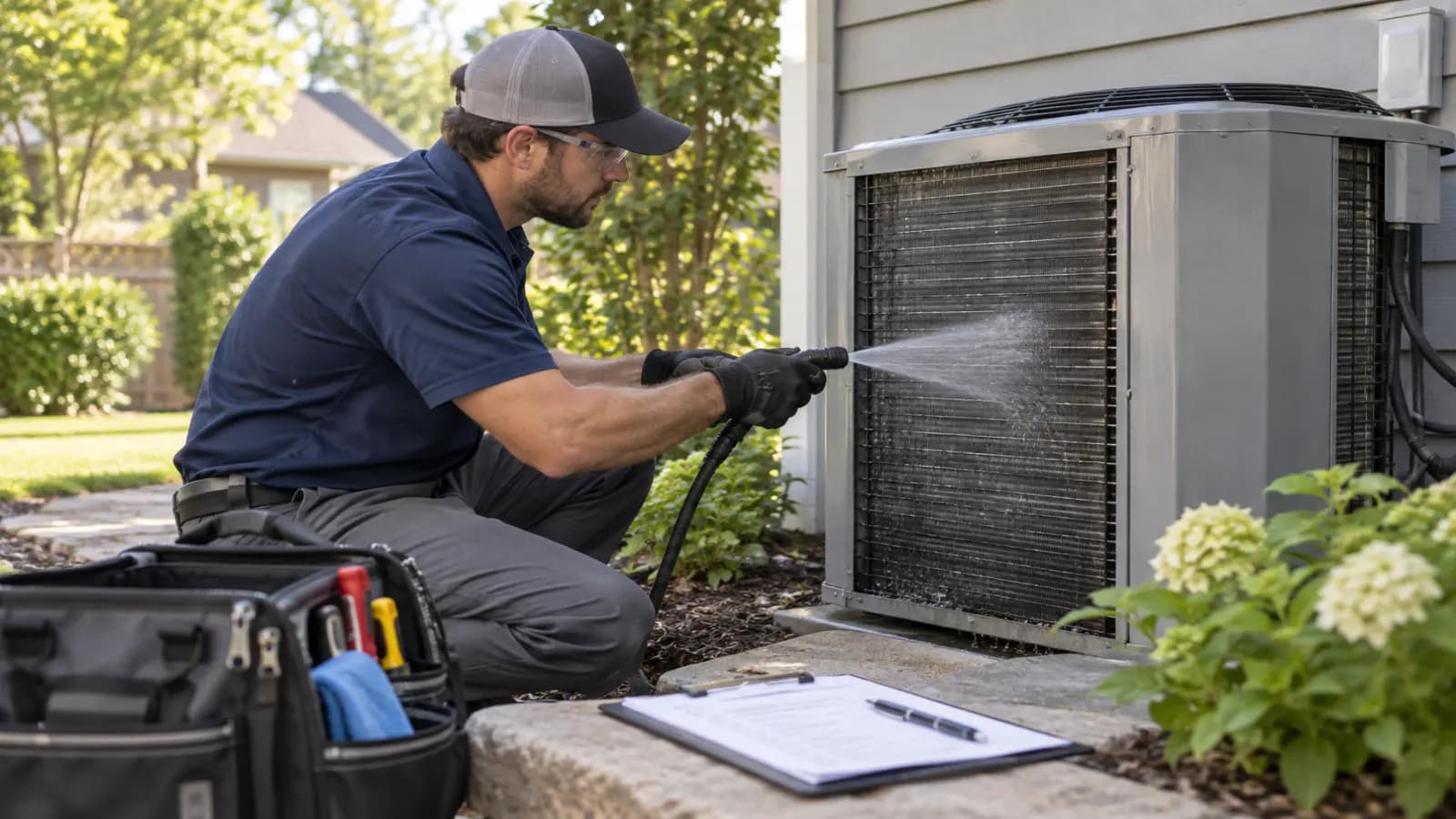
For central air conditioners and heat pumps in cooling mode, the technician should inspect the outdoor coil and cabinet, indoor coil where accessible, blower, condensate system, electrical components, and operating temperatures. Vegetation and debris should be cleared using methods appropriate for the manufacturer’s coil construction.
Refrigerant is not consumed like fuel. A low charge suggests leakage or an installation problem; routinely adding refrigerant without diagnosing the loss is not maintenance. Charge verification must use manufacturer procedures and suitable operating conditions. If the technician recommends refrigerant, ask for the measurements, suspected leak location, repair plan, and refrigerant type.
A useful report may include outdoor and indoor conditions, return and supply temperatures, airflow or static-pressure findings, refrigerant measurements when conditions allow, motor current, capacitor readings, drain and float-switch results, and coil condition. The exact values matter less to a homeowner than having a baseline and an explanation of anything outside specification.
Heating-system maintenance checklist
Fuel-burning equipment requires combustion and venting checks beyond a basic visual once-over. ENERGY STAR specifically identifies gas or oil connections, gas pressure, burner combustion, and the heat exchanger as heating-related maintenance areas. These tasks require trained personnel and appropriate instruments.
- Gas or oil furnace: inspect venting, combustion air, burner operation, ignition and flame proving, gas or oil connections, temperature rise, safety limits, and heat-exchanger condition using the manufacturer’s procedures.
- Heat pump: confirm heating-mode operation, outdoor coil condition, reversing-valve response, auxiliary heat, controls, and defrost behavior under conditions where testing is appropriate.
- Electric furnace or air handler: inspect heating elements, sequencers or controls, electrical connections, current draw, blower operation, temperature rise, and safety limits.
- Hydronic boiler: use a boiler-specific checklist covering combustion or electrical operation, venting, pressure, temperature, relief and safety controls, pumps, expansion provisions, and visible leakage.
Homeowner HVAC maintenance between visits
The safest homeowner tasks are simple and visible. Check the filter monthly during heavy use and replace or clean it when dirty according to the manual; ENERGY STAR says at minimum many filters should be changed every three months, but filter type, pets, smoke, renovations, and runtime can shorten that interval. Use the specified size and an airflow resistance compatible with the system.
Keep supply registers and return grilles open, clean, and unobstructed unless the system designer instructs otherwise
Remove leaves, grass, snow, and stored items from around outdoor equipment while preserving manufacturer clearances
Look for water around the indoor unit, a full drain pan, new rust, ice, unusual noise, repeated breaker trips, or persistent odors
Test smoke and carbon monoxide alarms on the schedule recommended by the alarm manufacturer and replace them at end of life
Record filter changes and observations with a date and photo; report developing problems before they cause secondary damage
Do not open sealed service panels, wash energized equipment, add refrigerant, bypass safeties, or use chemicals in a drain unless the manufacturer specifically assigns that task to the homeowner
How to compare tune-up offers without buying an upsell
A low promotional price can represent a limited inspection, an introductory offer, or a genuine seasonal discount. The price alone does not reveal the value. Compare the written task list, time allowance, technician qualifications, report delivered, consumables included, and whether cleaning or diagnostic work costs extra.
Ask the company to identify exclusions before arrival. ‘21-point tune-up’ is not meaningful if the points are undefined. Conversely, a contractor should not perform chargeable repairs simply because an inspection found a concern. Request the measurement, photo, fault history, manufacturer limit, or other evidence supporting a recommendation, then approve or decline it separately.
Maintenance plans may provide scheduling priority, discounted repairs, or included visits, but they are service contracts—not the manufacturer’s product warranty. Read cancellation, renewal, transfer, exclusions, and claim-administration terms before treating a plan as coverage.
What to do if an HVAC warranty claim is denied
Ask for the denial in writing with the exact warranty clause, failed part, and reason the company believes the claim is excluded. Preserve the part when practical, photos, diagnostic measurements, installation records, maintenance invoices, and communications. Do not surrender originals; send copies.
First follow the claim and appeal process in the warranty. Escalate from the servicing contractor to the distributor or manufacturer as the document directs. If the dispute remains unresolved, the FTC advises contacting a state attorney general or consumer-protection office and reporting suspected deceptive practices. Legal rights and implied warranties vary by state, so obtain qualified advice for a significant disputed claim.
The bottom line
An HVAC maintenance checklist cannot rewrite a warranty. Download the actual terms, follow the schedule for your model, keep installation and registration records, and require service invoices that describe the work rather than merely saying ‘tune-up complete.’ That combination protects the equipment and gives a future claim reviewer evidence to evaluate.
If your system is due for documented maintenance, submit your ZIP code and equipment details to request a free match with independent local HVAC technicians. Ask each provider for its written checklist before choosing, and remember that there is no obligation to hire through GetLocalExperts.
Frequently asked questions
Will missing one HVAC tune-up automatically void my warranty?
Not necessarily. Read the exact manufacturer warranty, installer labor warranty, or service contract. A document may exclude damage caused by inadequate maintenance without canceling every unrelated coverage obligation. Ask the warrantor to identify the specific term and causal basis for any denial.
Do I have to use the installing HVAC dealer for maintenance?
The written coverage controls, but federal law generally restricts tying warranty coverage to a specific paid service unless it is provided free or an FTC waiver applies. An installer’s separate labor warranty or purchased service contract may have its own lawful conditions. Keep qualified-service records regardless of provider.
How often should I change my HVAC filter?
Inspect it monthly during heavy heating or cooling use and follow the equipment and filter manufacturer instructions. ENERGY STAR says to change a dirty filter and, for many common filters, at least every three months. Pets, smoke, remodeling dust, filter area, and runtime may require more frequent changes.
Should an HVAC technician add refrigerant during a tune-up?
Not routinely. A sealed cooling system does not consume refrigerant. If measurements show a low charge, ask for leak diagnosis and a repair plan rather than approving an unexplained top-off. Charge testing must follow the equipment manufacturer’s method and appropriate weather and load conditions.
What should an HVAC maintenance invoice include?
It should identify the date, property, provider, equipment model and serial numbers, checklist tasks completed, observations and relevant measurements, parts or materials used, repairs authorized, and technician or company contact information. Keep proof of payment and any photos or electronic reports with it.
Cost ranges here are general research estimates compiled from national and regional data. They are not quotes, offers or price guarantees — only a licensed provider who has seen the job can price it. GetLocalExperts is a free matching service and does not perform home services.
Sources and further reading
- Warranties: Consumer Advice — Federal Trade Commission
- Businessperson’s Guide to Federal Warranty Law — Federal Trade Commission
- HVAC Maintenance Checklist — ENERGY STAR
- Heat and Cool Efficiently — ENERGY STAR
- ANSI/ACCA 4 QM Residential HVAC Maintenance Standard — Air Conditioning Contractors of America
This guide was researched and reviewed by the GetLocalExperts Editorial Team against primary regulatory benchmarks, state contractor licensing board standards, and FTC consumer protection guidelines.