Use these eight questions to verify a plumber, compare written estimates, uncover exclusions, and agree on permits, payment, cleanup, and warranties before work begins.
Looking for verified plumbing specialists? Check availability in seconds.
Check ZIP code availabilityStart with the written scope, not the lowest number
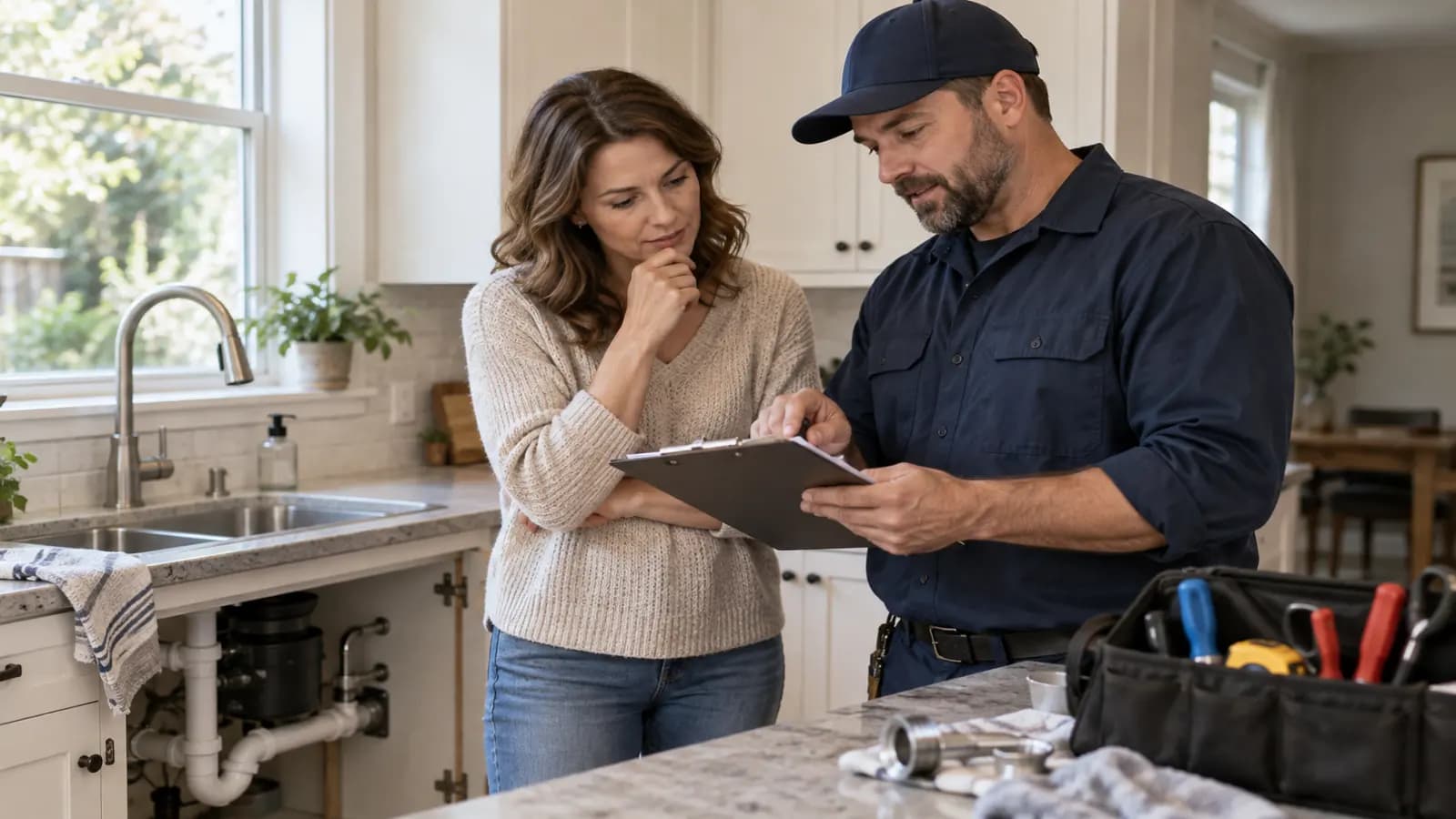
The best question is not simply, “How much?” A $450 repair and a $900 repair may not include the same diagnosis, parts, access, wall repair, permit, testing, or warranty. Before choosing a plumber, ask each company the same eight questions and compare the written answers line by line.
For an active leak, make-safe work may need to happen before a complete estimate is possible. Authorize only the emergency step you understand—such as shutting off water or stopping the leak—then request a documented diagnosis and written proposal for permanent repair. Do not let urgency turn an open-ended authorization into an unlimited bill.
1. What license or registration applies to this job, and can I verify it?
Plumbing credential rules vary by state and sometimes by city, county, job type, and project value. Ask for the exact legal business name, license or registration number, issuing authority, classification, and expiration date. Then use the issuing agency’s own lookup—not a badge on the company website—to confirm that the credential is active and appropriate for the work address.
Also ask who will perform and supervise the work. A company license does not necessarily tell you the status of the person arriving at your home. Apprentices and employees may legally work under supervision, while subcontractors may have separate credential and insurance obligations. The correct arrangement depends on local law; the company should be able to explain it plainly.
Legal business name matches the proposal
Credential is active with the correct issuing authority
Classification covers the proposed plumbing work
Complaint or disciplinary information is reviewed when the agency publishes it
The proposal identifies any subcontractor and responsible supervisor
2. Will you provide proof of insurance for this project?
Ask for evidence of current commercial general liability coverage and, when applicable, workers’ compensation coverage. Coverage requirements and exemptions vary, so verify with the insurer, agent, or official state system rather than treating a saved PDF as conclusive. Check the insured business name, policy dates, and whether the work will involve a separate subcontractor.
Your homeowners policy is not a substitute for the contractor’s business insurance. Ask your own insurer how a planned project or loss should be handled, especially for major remodeling, water damage, or an insurance claim. Never assume a contractor’s policy will pay for defective workmanship; policy terms and the cause of loss control coverage.
3. What exactly is included—and excluded—in the written scope?
The proposal should name the diagnosed problem and the specific repair, not just say “fix leak” or “replace pipe.” Ask for pipe or fixture material, manufacturer and model where relevant, quantities, access method, testing, protection of finished surfaces, debris removal, and the point at which additional work would require your approval.
Plumbing often crosses trade boundaries. Opening a wall does not automatically mean the plumber will replace insulation, patch drywall, reset tile, paint, move cabinets, remediate mold, or repair concealed framing. Similarly, a sewer excavation may exclude landscaping, concrete, utility locating, soil disposal, or engineering. Every exclusion that matters should appear beside the scope—not emerge on the final invoice.
4. Is the price fixed, hourly, or time-and-materials—and what can change it?
A fixed-price proposal states a price for a defined scope. Time-and-materials billing charges for labor time and materials under stated rates and markups. Neither method is automatically cheaper. The important question is what the number covers and what happens when site conditions differ from the assumptions.
Ask about the service-call or diagnostic fee, minimum labor charge, after-hours rate, travel, material markup, equipment fees, tax, permit cost, and whether the diagnostic charge is credited if you approve the repair. For hourly work, identify the labor unit: one technician, a crew, or each worker separately. Request a not-to-exceed amount or a mandatory approval checkpoint when the full scope cannot yet be known.
Do not accept “we’ll work it out later” for changes. A change order should describe the newly discovered condition, revised work, added or reduced price, and schedule effect before the extra work proceeds, except for a genuine emergency needed to prevent immediate harm.
5. Does the job require a permit or inspection, and who handles it?
Permit requirements are local. A repair that needs a permit in one jurisdiction may be exempt in another, and the rule may depend on whether the work involves a water heater, gas piping, sewer connection, backflow device, structural opening, or replacement rather than a minor repair. Confirm the answer with the local building or plumbing department when the scope is substantial or the explanations conflict.
If a permit is required, the written proposal should say who applies, who pays the fee, whose name appears on the permit, who schedules inspections, and who corrects failed inspection items. Be cautious if a contractor tells you to obtain an owner-builder permit merely for convenience; doing so may shift responsibilities or protections under local law.
6. Who will be in my home, and how will the site be protected and cleaned?
Ask whether the crew consists of employees or subcontractors, who supervises, expected arrival windows, and how the company identifies workers. For multi-day work, agree on water shutoff periods, restroom access, pets, keys, alarms, parking, material storage, and daily cleanup.
For a home built before 1978, plumbing access that disturbs painted surfaces may trigger the EPA Renovation, Repair and Painting Rule unless an exception applies. Ask whether the firm is EPA Lead-Safe Certified or certified under an authorized state program, who the certified renovator is, and how the work area will be contained and cleaned. EPA specifically identifies plumbing among work that can be covered by the rule.
If suspected asbestos, sewage, mold, or other hazardous material appears, pause and identify the appropriate qualified professional. A plumber’s license alone does not establish environmental-remediation credentials.
7. What warranties apply to labor and materials?
Ask for the contractor’s labor warranty separately from the manufacturer’s product warranty. Record the term, start date, covered failures, exclusions, service-call charges, response process, and whether the warranty transfers to a buyer. A long parts warranty can still leave you paying labor, shipping, diagnostics, demolition, or finish restoration.
Confirm who registers any product warranty and what documentation you will receive: paid invoice, model and serial numbers, permit closeout, inspection result, photos, maintenance instructions, and manufacturer paperwork. Do not rely on “lifetime” without a written definition of whose lifetime, which component, and which costs are included.
8. What are the payment schedule, cancellation terms, and final sign-off?
Deposit limits and contract rules vary by state. The Federal Trade Commission advises homeowners not to pay the full project amount upfront and notes that some states cap down payments. For a larger job, tie progress payments to clearly described, inspectable milestones—not only dates or vague percentages—and retain the final payment until the contracted work and required inspection are complete, subject to applicable law and the agreement.
Use a traceable payment method made to the contracting business and obtain receipts. Never sign a blank contract, and do not let anyone pressure you to assign insurance benefits, endorse a claim check, or finance work you do not understand. Read the cancellation language before signing; federal and state cancellation rights have conditions and exceptions, so a three-day cancellation period should never be assumed to apply to every plumbing sale or emergency visit.
Define final sign-off: restored water service, leak and function testing, safe operation, cleanup, approved inspection when required, lien releases where appropriate, warranty documents, and a paid invoice. Photograph concealed work before it is covered when the contractor and site conditions allow.
Red flags that justify slowing down or walking away
One concern may have an innocent explanation; a pattern deserves caution. The FTC recommends multiple written estimates, license and insurance checks, and a written contract. Stop and verify when a salesperson creates artificial urgency or refuses normal documentation.
A quick way to compare plumbing estimates
Make a simple table with one row for each bidder and columns for diagnosis, exact scope, exclusions, materials, access restoration, permit, price method, maximum exposure, schedule, credentials, insurance, warranty, and payment milestones. Mark “not stated” instead of filling gaps with assumptions.
Then compare the proposed solution. If one plumber recommends a spot repair and another recommends replacement, ask each to show the observed condition and explain why the alternative is unsuitable. A third diagnosis can be more valuable than choosing the middle price when the scopes solve different problems.
The bottom line
A trustworthy hiring decision is built from verifiable credentials and a complete written agreement—not a logo, review score, handshake, or low headline price. Ask the same eight questions, independently confirm what matters, and do not authorize work until the scope, price rules, permits, payment, cleanup, and warranties make sense.
If you need plumbing help, submit your ZIP code and project details to request a free match with independent local plumbers. Interview and verify any provider before hiring; there is no obligation to select a match through GetLocalExperts.
Frequently asked questions
What should I ask a plumber before hiring?
Ask about the credential required for your location and job, insurance, exact written scope and exclusions, pricing method, permits, who performs the work, site protection, labor and product warranties, payment milestones, and final sign-off. Verify important answers with the issuing agency, insurer, or local building department.
Should I hire a plumber who charges hourly or a flat rate?
Either can be reasonable. Compare the defined scope and total financial exposure. For hourly work, ask about minimums, crew rates, material markup, travel, and an approval or not-to-exceed threshold. For fixed-price work, ask which assumptions or concealed conditions can change the price.
How do I verify that a plumber is licensed and insured?
Get the legal business name, license or registration number, issuing authority, classification, and expiration date, then check the official state or local lookup that governs the work address. For insurance, confirm current coverage with the insurer, agent, or official state system and check that the named insured matches the contracting business.
How much should I pay a plumber upfront?
There is no single nationwide deposit percentage. State limits and project needs vary. Do not pay the full project price upfront; for larger work, use lawful payments tied to specific, inspectable milestones and keep receipts. Review your state’s contract and deposit rules before signing.
Does a plumber need to pull a permit?
It depends on the jurisdiction and scope. Minor repairs may be exempt while water-heater, gas, sewer, backflow, or extensive replacement work may require permits and inspections. Ask the plumber, then confirm uncertain or conflicting answers with the local building or plumbing department.
GetLocalExperts is a free matching service and is not the contractor. Verify current licensing and insurance with the issuing state board or insurer before hiring, and get every scope and price in writing.
Sources and further reading
- How To Avoid a Home Improvement Scam — Federal Trade Commission
- Cooling-Off Rule: When and How to Cancel a Sale — Federal Trade Commission
- Checklist to Ask Your General Contractor — Federal Emergency Management Agency
- Beware of Fraudulent Contractors — Federal Emergency Management Agency
- Renovation, Repair and Painting Program: Contractors — U.S. Environmental Protection Agency
- Find a Lead-Safe Certified Firm — U.S. Environmental Protection Agency
This guide was researched and reviewed by the GetLocalExperts Editorial Team against primary regulatory benchmarks, state contractor licensing board standards, and FTC consumer protection guidelines.