Stop use, protect people and evidence, map the water path, and use controlled testing to distinguish supply, drain, receptor, enclosure, condensation, and surrounding-wall failures.
Looking for verified bathroom-remodeling specialists? Check availability in seconds.
Check ZIP code availabilityStop use and screen for immediate hazards
Take the shower or tub out of service and prevent accidental use. Do not run one more cycle to confirm the leak. Water can travel away from the source through framing, fasteners, insulation, wiring, light fixtures, and ceiling cavities, so the visible stain is not a safe test location.
Keep people away from a bulging, sagging, cracked, dripping, or unusually heavy ceiling. Do not puncture or press it, stand below it, or place a ladder against it. If water is near lights, fans, receptacles, switches, appliances, or the electrical panel, do not touch wet devices or enter standing water. Use emergency services and a qualified electrician when conditions may be energized or structurally unsafe.
Shut off an accessible fixture or branch valve only from a dry, safe location and only if the suspected leak continues without shower use. Leave a gas odor, sewage, contaminated water, major structural movement, or rapidly spreading water to the appropriate emergency, utility, plumbing, mitigation, or building professional.
Preserve a baseline before anything is opened
Photograph and video the shower, drain, controls, enclosure, floor outside, baseboards, adjacent rooms, ceiling or wall below, and contents. Include wide room views and closeups with a date, scale, and opening ID. Record when the condition was first noticed, last shower use, whether it occurs during or after use, occupants' observations, prior repairs, and recent plumbing or weather events.
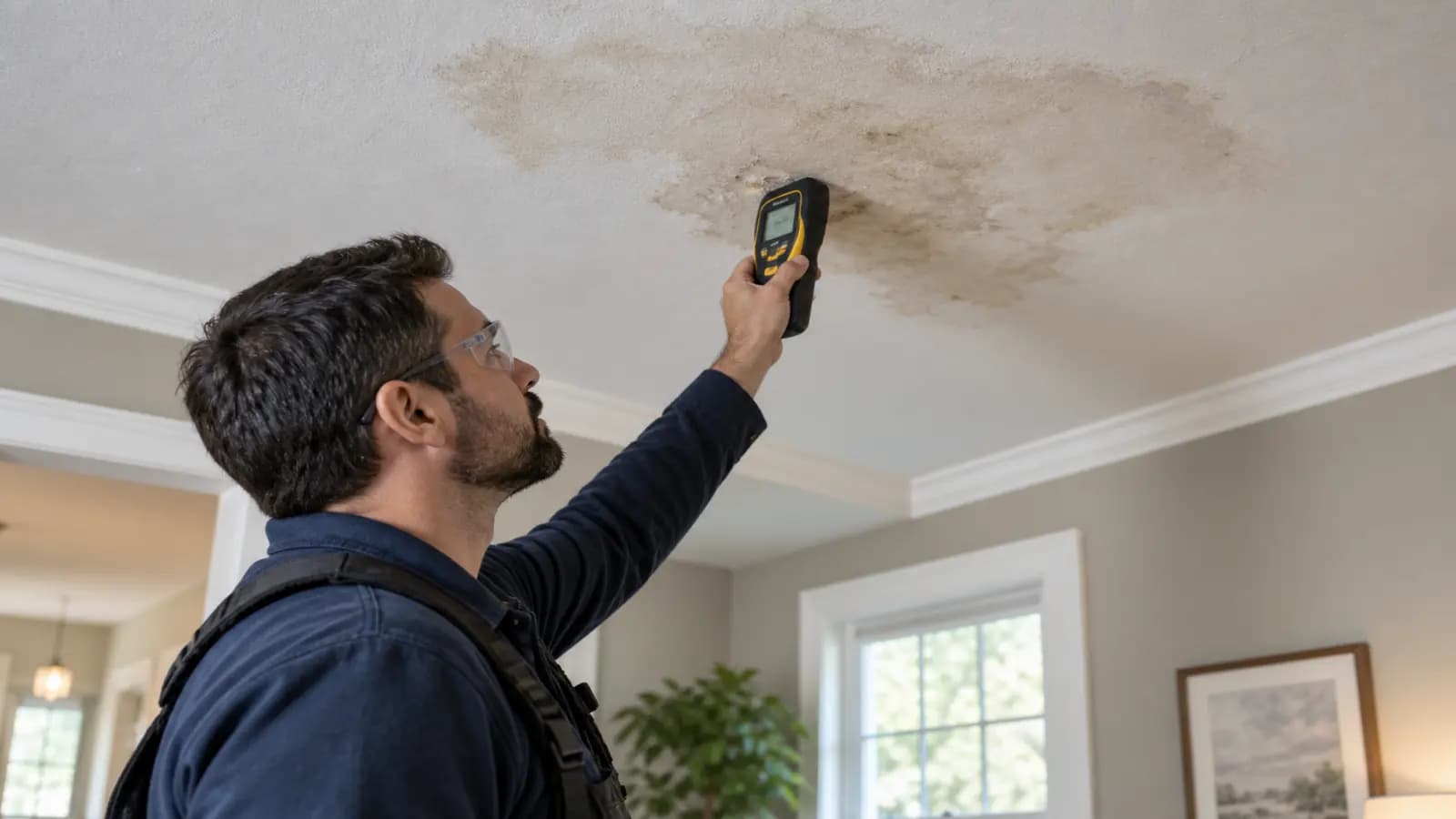
Map visible stain boundaries without touching unsafe material. Record odor, finish changes, loose components, and moisture-meter readings only when obtained safely and with the instrument, material setting, location, and limitations identified. A meter can help map relative conditions; it does not identify the leak source, mold species, or concealed damage by itself.
Notify the insurer or property manager promptly when damage may be covered and follow instructions for emergency mitigation and preservation. NAIC provides general guidance that household plumbing or roof-leak water damage is typically covered, but the actual policy, cause, exclusions, repeated-seepage language, duties, deductible, and facts control the claim.
Separate active pressure leaks from use-related leaks
Observe the home while the shower remains unused. A stain, drip, meter movement, or wet area that continues can point toward a pressurized supply, another fixture, plumbing above, HVAC condensate, roof or exterior water, or a source unrelated to the shower enclosure. Do not assume correlation from room location.
A leak that appears only after shower use may involve the showerhead arm, valve trim, supply under operating conditions, drain and trap, receptor or liner, wall waterproofing, penetrations, enclosure, threshold, splash-out, or floor outside. Condensation from an unvented or poorly performing fan can wet finishes without a plumbing failure. Multiple sources can coexist.
A qualified diagnostician should create a hypothesis list before testing and identify the least destructive way to isolate each source. Baseline readings and a dry-down period improve test meaning. Testing everything at once only proves that the shower can leak; it does not show where.
Use a controlled diagnostic sequence—not homeowner flood experiments
Do not plug a shower drain, hold water for an arbitrary hour, cap a shower arm, spray walls while blocking the drain with a towel, or repeatedly run fixtures without professional control. Improvised plugs can test the wrong boundary, overflow a receptor, stress unverified plumbing, damage finishes, or add water to an already wet cavity.
After safety review and baseline documentation, qualified trades may test supply pressure or components, operate the valve and outlets, isolate drain flow from wall wetting, evaluate drain and trap connections, test the receptor or waterproofing under an applicable method, and wet enclosure zones in a controlled sequence. The test plan should state boundaries, volume or pressure, duration, observation points, stop conditions, and responsibility for damage.
Where access exists from a service panel, crawlspace, or unfinished ceiling, direct observation can reduce guesswork. Borescopes, moisture mapping, thermal imaging, pressure testing, dye used under an appropriate protocol, and selective openings are tools—not conclusions. Each has false positives, blind spots, and conditions that require trained interpretation.
Read symptoms as clues, not verdicts
A stain directly beneath a drain can still originate at a wall and travel along framing. Dark grout can reflect moisture, cleaning residue, material variation, or limited drying. White deposits can indicate dissolved salts carried by moisture, but they do not identify the failed layer. Hollow-sounding or loose tile can have bonding, substrate, movement, impact, or moisture causes.
A loose escutcheon, cracked grout, missing sealant, worn door sweep, or open corner deserves correction, yet a visible surface defect does not prove it is the only water path. Tile and grout are not substitutes for the wet-area waterproofing assembly. Conversely, a sound membrane cannot prevent splash from escaping an unsuitable enclosure.
Document patterns: exact use condition, onset delay, amount, temperature, location, weather, fan operation, door position, user direction, and whether the condition changes with other fixtures. Repeat only a safe, approved test after the assembly has returned to the defined baseline.
Inspect the complete shower and surrounding assemblies
Identify receptor or tub, drain and connection, trap, waste and vent, valve, outlets and supply joints, wall board, waterproofing or liner, seams, corners, penetrations, niche, bench, curb or threshold, enclosure, fasteners, window, bathroom floor, wall base, framing, insulation, and ceiling below. Obtain permits, construction photos, product records, and installer information if available.
Check whether water can be cleaned and dried from every affected layer. Vinyl, tile, or a painted ceiling surface may look intact while insulation, wood panels, drywall paper, framing, or cabinets remain wet. Selective removal should be planned around the most informative and least damaging access, not automatically made at the stain.
Before disturbance, evaluate older flooring, mastic, wall materials, insulation, and glazing compounds for asbestos or other hazards as appropriate. Paid work disturbing paint in many pre-1978 homes may fall under EPA or authorized-state lead-safe requirements. Do not sand, cut, or demolish suspect materials casually to find a leak.
Begin drying while diagnosis and claim work continue
EPA emphasizes prompt moisture control and says wet materials should ideally be dried within 24–48 hours to reduce mold risk. That is an urgency target, not proof that a cavity is safe at hour 47 or automatically contaminated at hour 49. Source, temperature, materials, ventilation, prior wetting, and access matter.
After electrical and structural safety are addressed, qualified mitigation can remove bulk water, expose wet layers where necessary, control humidity, and use appropriate airflow or heat. Do not aim fans into visible mold or spread contamination through HVAC. Do not close, paint, or tile over wet material or visible biological growth.
CDC advises that people with allergies, immune suppression, underlying lung disease, asthma, or COPD should not perform mold cleanup and may need to stay away. Cleanup method and protective equipment depend on extent, material, contamination, and occupant risk. Extensive, hidden, recurrent, or contaminated conditions warrant experienced professional help.
Verify drying with a mapped record
Create a diagram of consistent measurement locations across shower walls, floor, curb, bathroom floor, base plates, adjacent walls, ceiling below, framing, and unaffected reference areas. Record instrument, material, setting, depth where relevant, ambient temperature and relative humidity, date and time, equipment changes, and each result.
Drying completion criteria should be defined by the affected materials, equipment, accepted restoration practice, building conditions, and intended repair—not “feels dry” or one low surface reading. Compare trends with justified reference conditions and investigate readings that plateau or rebound after equipment stops.
The closeout record should show source correction, removed and retained materials, cleaning or remediation, drying results, photographs, and readiness for reconstruction. Moisture meters do not certify structural capacity, microbial cleanliness, waterproofing, or plumbing integrity; those require separate evaluation and tests.
Match the repair boundary to the proven failure
A door sweep, enclosure seal, showerhead-arm connection, trim seal, accessible drain gasket, or serviceable valve component may support a localized repair when controlled testing and inspection show the underlying assembly remains suitable. Use compatible products, follow manufacturer instructions, and retest the isolated condition before finishes close.
Repeated surface caulking or regrouting is not a diagnosis. If joints reopen, substrate moves, water remains behind the finish, or testing implicates the receptor or waterproofing, cosmetic work can delay access while damage grows. Surface-applied sealer cannot reconstruct a failed hidden assembly.
A receptor, liner, membrane, drain-integration, substrate, or structural failure may require removal to a boundary that permits a continuous compliant rebuild. Full shower demolition is not automatic; neither is a small patch. The repair designer should show how new work connects to verified retained waterproofing and who warrants that transition.
Rebuild with commissioning—not just new finishes
The repair scope should name structural corrections, plumbing components, receptor, drain, waterproofing system, boards, seams, corners, penetrations, niches, curb, enclosure, ventilation, electrical work, tile and grout, flexible joints, trim, ceiling and paint restoration, permits, and inspections. Avoid incompatible product mixing without written approval and responsibility.
Define applicable supply, drain, receptor or waterproofing tests before tile and again commission the operating shower after completion. Record test method, conditions, witnesses, results, corrections, and retest. Check valve and outlets, drain performance, enclosure and threshold, splash behavior, fan exhaust outdoors and delivered airflow where required, and adjacent finishes.
Preserve concealed-work photos, product and lot information, technical sheets, permits, inspection approvals, testing, moisture record, warranties, care instructions, spare materials, and responsible contacts. The evidence is particularly important when a repaired wet-area transition or retained component remains.
Use one written diagnosis-to-repair scope
Align plumber, tile or waterproofing professional, mitigation firm, electrician, environmental consultant where needed, insurer, and reconstruction contractor before permanent work. The homeowner should not have to reconcile incompatible assumptions after demolition.
Safety hazards, shower shutdown, emergency protection, insurer notice, photographs, chronology, opening IDs, prior repairs, and preserved evidence
Baseline moisture map, source hypotheses, controlled test plan, access points, stop conditions, findings, limitations, and diagnosed failure boundary
Hazardous-material and lead assumptions, containment, occupant protection, selective demolition, disposal, cleaning or remediation, and HVAC controls
Drying equipment, safe power, daily ambient and material readings, reference areas, completion criteria, source correction, and written dry standard
Repair drawings and products, plumbing and structure, waterproofing transitions, enclosure, ventilation, electrical and finishes, permits, inspections, tests, and warranties
Itemized price, insurance versus owner scope, allowances and unit prices, written changes, schedule, payment milestones, punch list, final reports, photos, manuals, and spare materials
The bottom line
A shower leak is solved by controlling risk and evidence, not by adding more water until a stain appears. Stop use, address electrical and ceiling hazards, document a baseline, distinguish active from use-related moisture, test one hypothesis at a time under professional controls, expose and dry the complete affected assembly, and match the repair boundary to the proven failure.
If you need leak diagnosis or repair, submit your ZIP code, shower type and age, last use, visible damage and rooms affected, whether moisture continues with no use, electrical or ceiling concerns, prior repairs, home age, insurer status, and available construction records to request a free match with independent local bathroom or restoration professionals. Use emergency help first for immediate hazards. Verify credentials, licensing where required, insurance, lead-safe certification when applicable, written test plan, and repair warranty before hiring; there is no obligation to choose a matched provider.
Frequently asked questions
What should I do first if my shower is leaking into the ceiling?
Stop using the shower, keep people away from a sagging or dripping ceiling, and do not touch wet electrical devices or enter standing water. Document conditions and contact emergency, electrical, plumbing, mitigation, insurer, or property-management help as appropriate. Do not puncture the ceiling or recreate the leak casually.
How can a professional tell whether a shower leak is from the drain or waterproofing?
After baseline moisture documentation, a qualified professional can isolate supply, controlled drain flow, receptor, walls, penetrations, and enclosure conditions one at a time while observing safe access points. Test boundaries, volume or pressure, duration, stop conditions, and limitations should be recorded; one stain location is not diagnostic.
Can regrouting or recaulking stop a shower leak?
It can correct a verified surface or enclosure joint problem when the underlying assembly is sound. It cannot reconstruct a failed receptor, membrane, drain integration, moving substrate, or wet damaged framing. Repeated caulking without diagnosis may hide symptoms while concealed damage continues.
Does a leaking shower always need to be completely rebuilt?
No. A localized plumbing, hardware, enclosure, or compatible waterproofing repair may be appropriate when the failure is proven and retained work can be inspected, dried, connected, tested, and warranted. A continuous rebuild may be needed when the receptor, membrane, substrate, structure, or transition cannot be reliably retained.
Does homeowners insurance cover a leaking shower?
Coverage depends on the policy, cause, timing, exclusions, prior damage, and homeowner duties. NAIC provides general guidance that household-plumbing water damage is typically covered, but gradual leakage, failed materials, mold, repair of the source, and resulting damage may be treated differently. Notify the insurer promptly and preserve evidence.
Emergency planning information, not electrical, plumbing, structural, mold, environmental, medical, code, or insurance advice. Stop using the shower. Keep away from sagging ceilings, wet electrical devices, and unsafe openings, and use emergency services or appropriately qualified local professionals as conditions require.
Sources and further reading
- A Brief Guide to Mold, Moisture and Your Home — U.S. Environmental Protection Agency
- Mold Course Chapter 3: Finding Mold and Moisture — U.S. Environmental Protection Agency
- Biological Contaminants and Indoor Air Quality — U.S. Environmental Protection Agency
- Mold Cleanup Guidelines and Recommendations — Centers for Disease Control and Prevention
- Consumer Homeowners Insurance — National Association of Insurance Commissioners
- International Plumbing Code Resource Collection: Shower Receptor Testing — International Code Council
- Renovation, Repair and Painting Program: Contractors — U.S. Environmental Protection Agency
- I'm Remodeling My Home. Do I Need to Be Concerned About Asbestos? — U.S. Environmental Protection Agency
This guide was researched and reviewed by the GetLocalExperts Editorial Team against primary regulatory benchmarks, state contractor licensing board standards, and FTC consumer protection guidelines.